Projects

Five engagements. Two domains. One platform.

Stark Solar Semi's portfolio spans Solar Manufacturing (cell, ingot, wafer) and Energy Storage (BESS module and pack assembly) — laddered across execution maturity from a live flagship to active pipeline.

01 / Solar Manufacturing

Cell, ingot and wafer engagements

Four engagements spanning the upstream-to-cell value chain — from a flagship under execution today to active pipeline conversations for giga-scale upstream.

1.3 GW G12R N-Type TOPCon Cell facility — Hyderabad
Under execution

1.3 GW G12R N-Type TOPCon Cell — Hyderabad

Technology

n-Type TOPCon LPCVD

Format

G12R cut cells

Differentiator

Post-cut EPD

Location

Hyderabad

Stark Solar Semi is engaged as Owner's Representative, Execution Partner, and Manufacturing Enabler for a 1.3 GW n-Type TOPCon solar cell manufacturing facility in Hyderabad. This is the company's flagship engagement and the most advanced project in the portfolio — currently under active execution. The facility will produce G12R cut cells using LPCVD-based TOPCon technology, with post-cut Electroluminescence and Power Detection (EPD) as a key quality differentiator.

Stark's scope

  • Technology selection and cell architecture advisory
  • Equipment procurement and OEM negotiation
  • Factory layout, process-flow and cleanroom design
  • Utility and infrastructure planning (UPW, gases, HVAC, ETP)
  • Installation supervision and commissioning management
  • Quality systems, yield engineering and ramp-up support
  • Workforce planning and training architecture

Technical differentiators

  • LPCVD-based TOPCon process — higher passivation quality and long-term efficiency stability
  • Post-cut EPD — full electroluminescence and power testing after cell cutting, not before
  • G12R format — optimised for next-generation module architectures and higher energy density
  • Integrated MES and SCADA — real-time traceability from wafer-in to cell-out
  • Designed for ALMM List-II eligibility from day one

Project outcomes

  • Fully operational 1.3 GW cell line — commissioning through steady-state production
  • ALMM List-II certified facility contributing to India's domestic manufacturing base
  • Replicable factory blueprint for future capacity expansion
  • Trained Indian workforce capable of sustaining operations independently
  • Demonstration of Stark Solar Semi's end-to-end execution model at scale
Advanced engagement

2.4 GW G12R N-Type TOPCon Cell Manufacturing

Hyderabad, India · LPCVD Route · G12R Cut Cells · Post-Cut Edge Passivation Deposition (EPD)

Site secured · State incentives in process

01   Project snapshot

Capacity

2.4 GW

Post-yield · annual

Technology

TOPCon

n-Type · LPCVD route

Format

G12R

Cut cells · 9.2 W target

Site

Brownfield

~185k sq.ft · Hyderabad

Sponsor

International BNEF Tier 1 module manufacturer

Operating footprint across multiple countries · Entering Indian solar cell market through this flagship capacity

Stark Solar Semi role

Integrated Implementation Partner (IIP)

18 work streams · Owner-side engineering · Vendor selection · Execution control · India operating presence

02   Project parameters

Capacity2.4 GW (post-yield)
Technology routen-Type TOPCon · LPCVD
Cell formatG12R cut cells
Target cell wattage~9.2 W
Target efficiency~24.9%
Annual cell output~261 M cells / year
Process steps15-step cell line
DifferentiatorPost-cut EPD
Site footprint~185,000 sq.ft.
Site statusBrownfield · under construction
Timeline targetT0 + 12 months to COD
Policy alignmentALMM List-II · FY 26-27

Technical differentiators

01

LPCVD tunnel oxide

+ intrinsic poly-Si route

02

G12R cut-cell

architecture · laser singulation

03

Post-cut EPD

for edge recombination control

04

AGV-enabled

material flow · smart factory ready

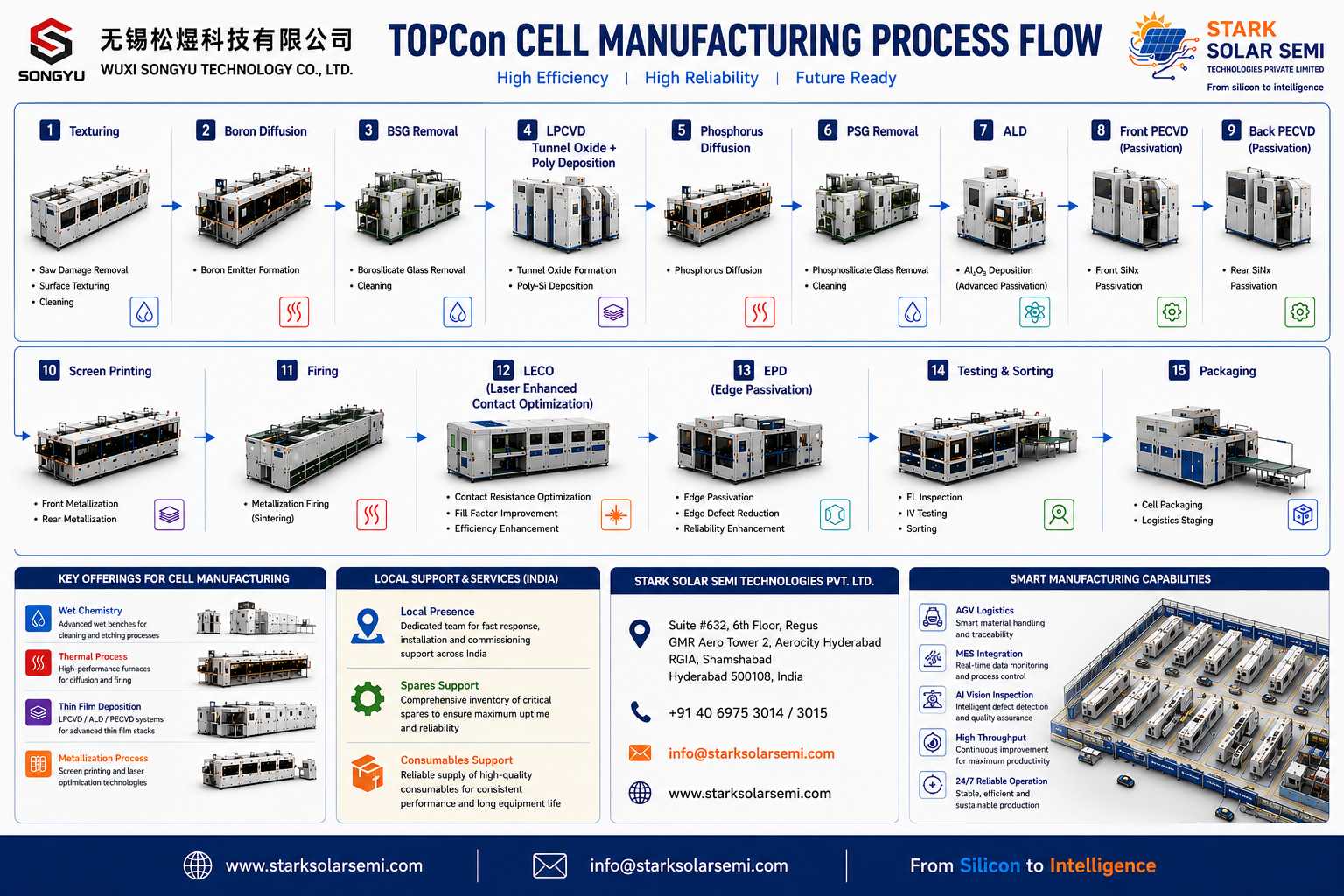
03   15-step cell manufacturing process flow — LPCVD route

1Texturing
2Boron Diffusion
3BSG Removal
4LPCVD Oxide
5P-Diffusion
6PSG Removal
7ALD
8Front PECVD
9Back PECVD
10Print
11Firing
12LECO
13EPD
14Test / Sort
15Pack
Junction formation (Steps 1-6) · Boron + Phosphorus diffusion, BSG / PSG cleaningPassivation & metallisation (Steps 7-12) · ALD + PECVD stack, print, fire, LECO Step 13 — Post-cut EPD (Edge Passivation Deposition)

04   Utility backbone

PPower

45 – 50 MVA

Plant supply · transformer-fed

WRaw Water

8 – 10K KLD

Peak demand · planning basis

UUPW

300 m³/hr

Ultra Pure Water · process

EETP

2.5 – 3K KLD

Acid / alkali equalisation

05   Stark Solar Semi — IIP scope

Project structuring & technology alignment
TOPCon LPCVD line planning & line balancing
Owner-side engineering & vendor selection
Equipment configuration & integration planning
Utilities, cleanroom & smart factory integration
Layout review & engineering validation
Commissioning planning & ramp-up support
End-to-end execution roadmap delivery

Integrated

Full owner-side execution across 18 work streams

Bankable

Lender-grade engineering, vendor & layout discipline

Differentiated

G12R cut-cell architecture with post-cut EPD recovery

Policy-aligned

ALMM List-II window · domestic-cell premium positioning

Time-to-COD

Brownfield path · T0 + 12 months target

Indicative. All scope, capacity, technology, site, timeline and policy alignment figures shown here are indicative and subject to detailed engineering, OEM finalisation, Telangana state approvals, ALMM listing, financing structure, and definitive project agreements. Sponsor identity is described generically; commercial structuring, cost of production, IRR, DSCR, capex composition and financing parameters are not disclosed publicly and are reserved for definitive commercial documentation under appropriate confidentiality.

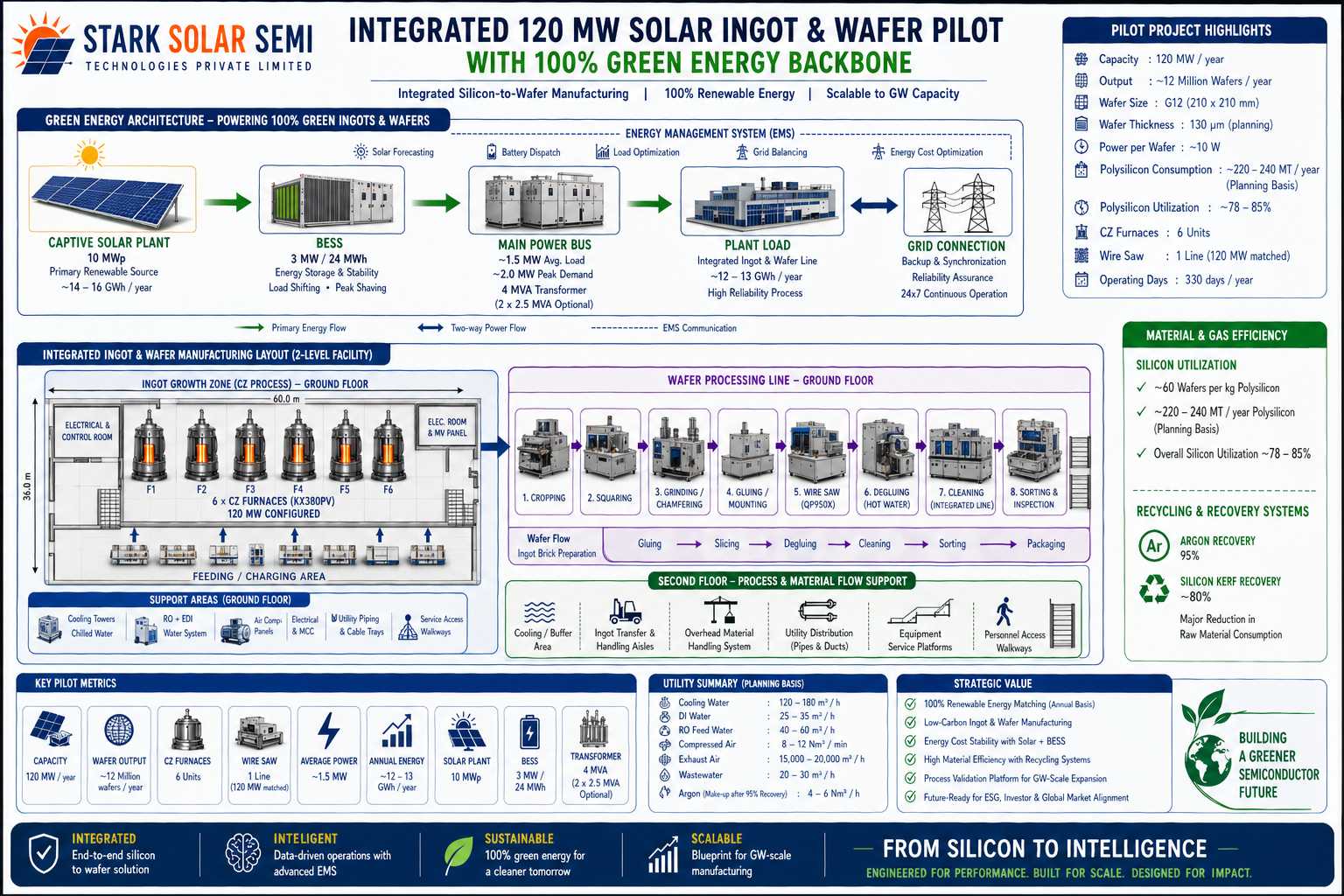
120 MW Pilot Ingot and Wafer Plant
Validation design

120 MW Pilot Ingot & Wafer Plant

Capacity

120 MW / year

Wafer platform

G12R 210 x 210 mm 130 μm

Output

~12 M wafers / year

Core equipment

6x KX380PV + 1x QP950X

Footprint

72 x 52 m

Power

10 MWp solar + 3 MW / 24 MWh BESS + 4 MVA grid

The 120 MW pilot ingot and wafer plant is a validation platform designed to prove out equipment integration, process parameters, and factory operations at a meaningful but capital-efficient scale before committing to giga-scale upstream investment. It serves as a replicable blueprint — demonstrating that Indian-assembled ingot and wafer capacity is technically and commercially viable, and providing the operational data needed to de-risk larger deployments.

Strategic value

  • Validates ingot growth and wafer slicing at commercial scale before giga-scale commitment
  • Proves CZ puller and diamond-wire saw integration with Indian workforce and infrastructure
  • Generates real operational data — yield, throughput, cost — for investor and policy confidence
  • Establishes a trained Indian workforce for upstream solar manufacturing
  • Creates a replicable factory blueprint scalable to GW-level capacity
  • Supports India's strategic push toward upstream self-sufficiency in the solar value chain
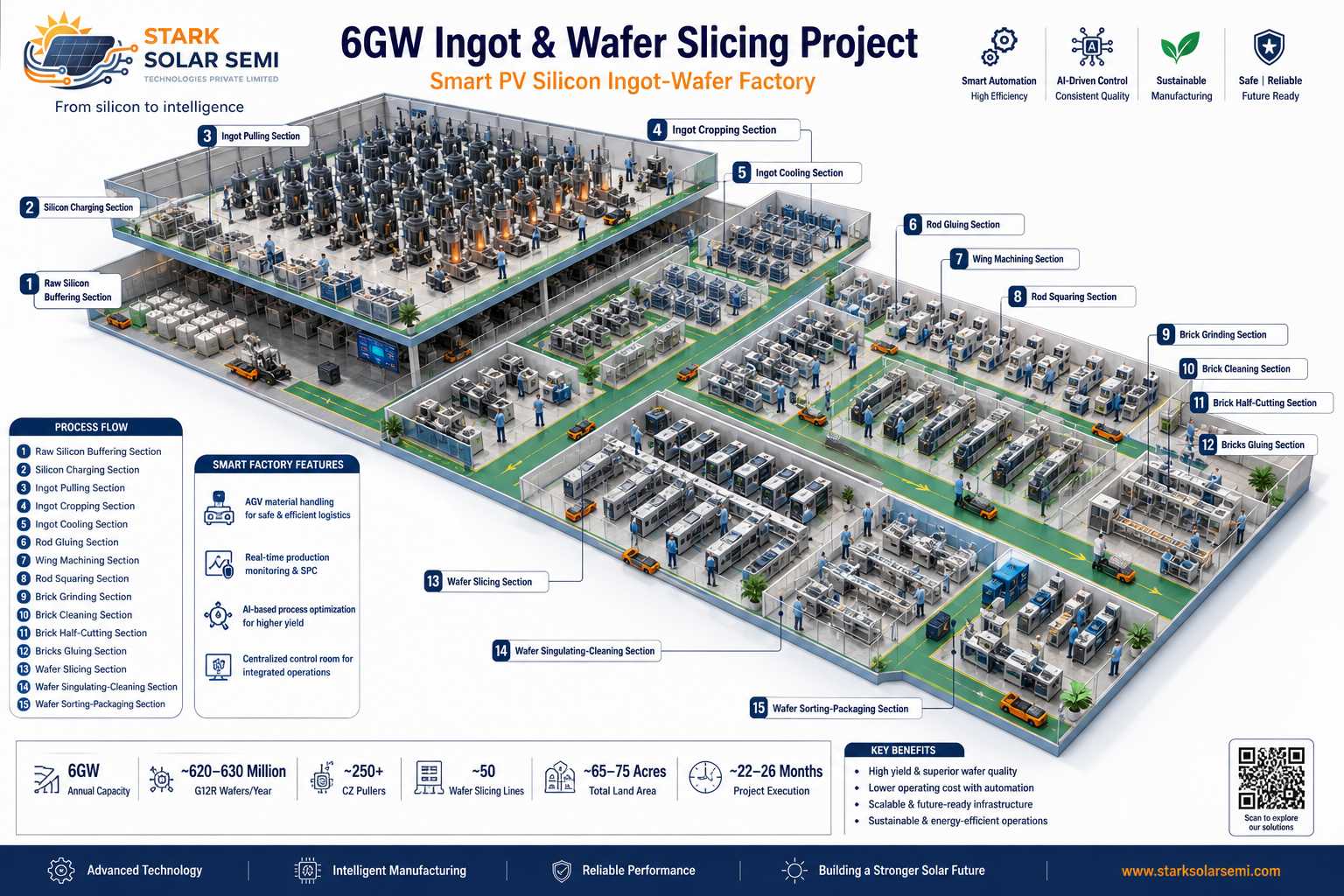
6 GW Ingot and Wafer Slicing Project
Active discussions

6 GW Ingot & Wafer Slicing Project

Capacity

6 GW

Output

~620 – 630 M wafers / year

Equipment

~250+ CZ pullers ~50 slicing lines

Land

~65 – 75 acres

Timeline

~22 – 26 months

Stark Solar Semi is in active discussions around a giga-scale 6 GW ingot growth and wafer slicing platform — a facility that would represent one of the largest upstream solar manufacturing investments in India. The project envisions 250+ Czochralski crystal pullers and approximately 50 diamond wire slicing lines, producing 620 – 630 million wafers per year for domestic cell manufacturers and export markets.

This project is at the active discussion stage. Parameters are indicative and reflect current planning assumptions. Final scope, capacity, and timeline are subject to investment structuring and partner alignment.

02 / Energy Storage

BESS module and pack assembly

Stark Solar Semi is building captive BESS module and pack assembly capacity to serve India's accelerating energy-storage demand — combining Chinese automation technology with Indian manufacturing execution.

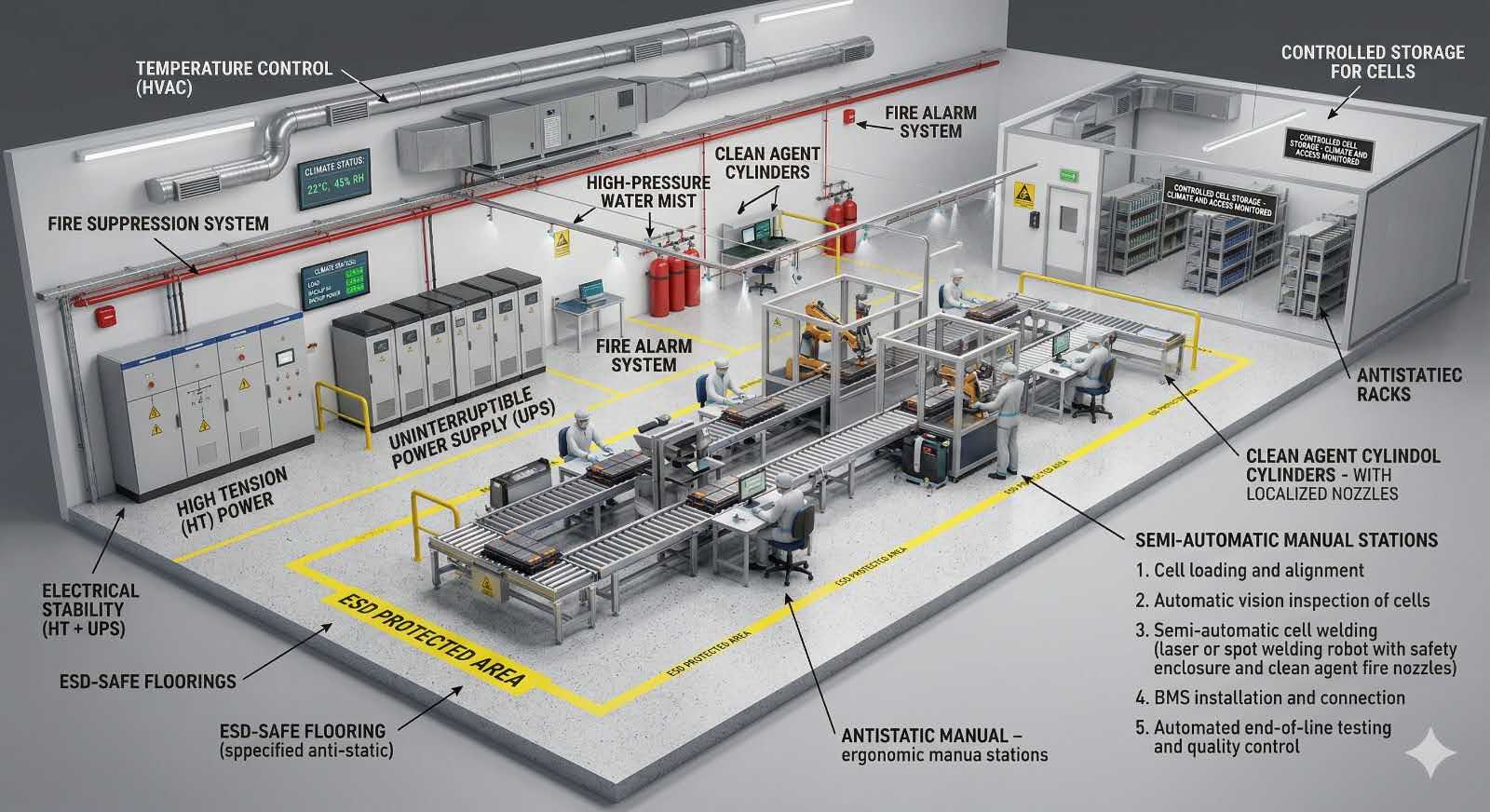
2 GWh Semi-Automatic BESS Module and Pack Assembly Line
Active development

2 GWh Semi-Automatic BESS Module & Pack Assembly Line

Annual capacity

2 GWh

Architecture

Semi-automatic 17-station

Operation rate

≥ 90%

Traceability

SCADA

Changeover

~30 min

Applications

Utility-scale and C&I

Stark Solar Semi is developing a captive 2 GWh BESS module and pack assembly line — a semi-automatic, 17-station production system designed for utility-scale and commercial & industrial energy-storage applications. The line is being developed in collaboration with iHydrogen Solutions Pvt. Ltd., the sister company focused on green hydrogen and electrolyser manufacturing, leveraging shared execution infrastructure, supply-chain relationships, and workforce capability across both platforms.

Demand pools served

  • Utility-scale BESS for grid firming, peak shaving, and renewable integration
  • Commercial and industrial (C&I) behind-the-meter storage
  • Captive BESS for solar-plus-storage hybrid projects

Stark's scope

  • Assembly line specification and equipment procurement
  • Factory layout, ESD protection and fire-suppression design
  • SCADA integration and end-of-line testing architecture
  • Cell sourcing strategy and supply-chain structuring
  • Quality management system and product certification pathway
  • Workforce training and operational readiness

This project is under active development. Capacity and configuration parameters reflect current design assumptions and may be refined as the engagement progresses toward final investment decision.

Bring us your project.

From greenfield giga-scale to legacy line upgrade — Stark Solar Semi provides the execution layer between ambition and production. Let's talk.

Start a project conversation